Soil decontamination in Quebec: steps, methods and costs
Published on by Emphase Environnement
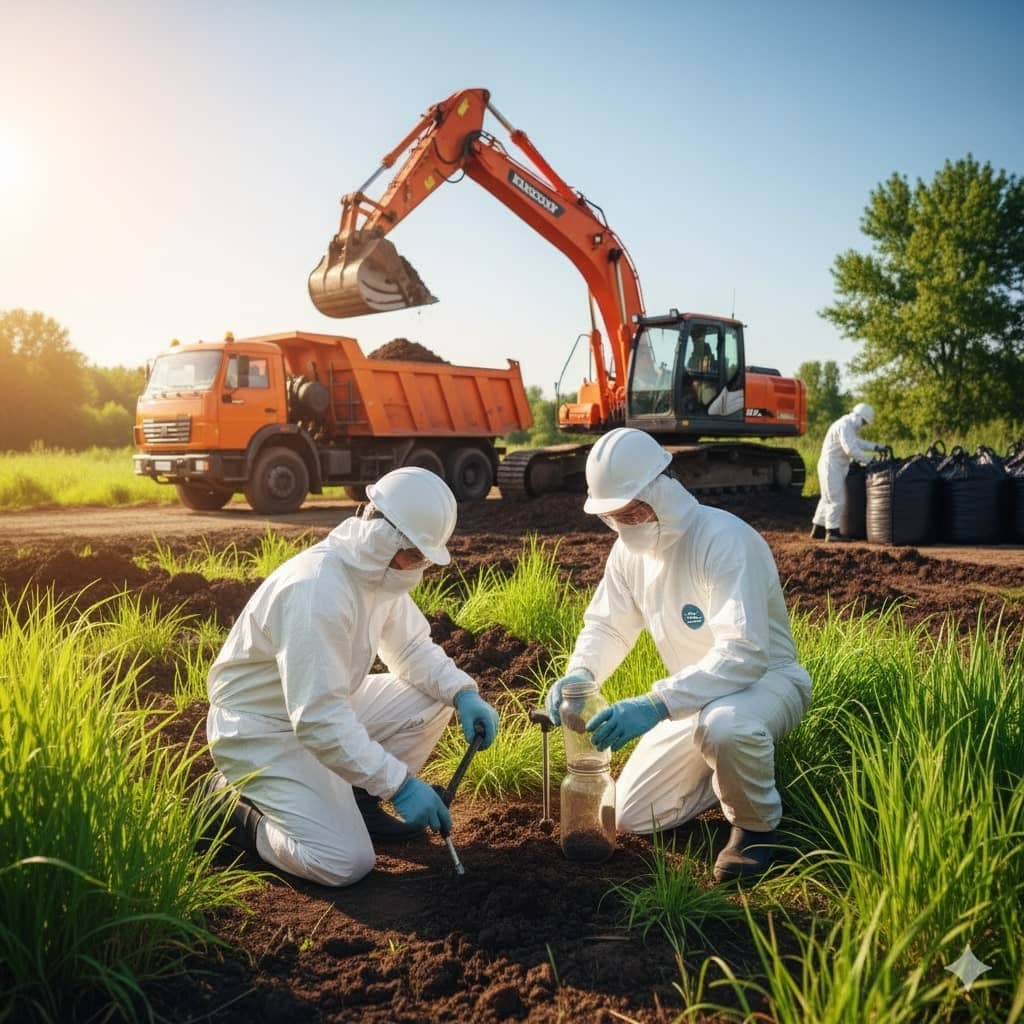
Decontaminating land in Quebec happens in four stages: characterize the contamination, choose the method and get the plan approved when the law requires it, carry out the work, then prove with laboratory analysis that the limit values are met. In most projects, the method chosen is excavating the contaminated soil and trucking it to an authorized facility. The cost depends mainly on the volume of soil, its level of contamination and the planned use of the land: that is why a good characterization is the first way to keep it under control.
When do you have to decontaminate?
Contaminated soil does not always mean you have to act right away. Decontamination becomes necessary in four situations.
- A transaction or financing. The buyer or lender requires a compliant site.
- A change of use. Under sections 31.53 and 31.54 of Quebec's Environment Quality Act (EQA), changing the use of land where a listed industrial or commercial activity took place requires a characterization study. If the limit values are exceeded, the change requires the Minister's approval of a remediation plan.
- Ceasing a listed activity. Section 31.51 allows 12 months to submit a characterization study, then three months to submit a remediation plan if the limit values are exceeded.
- An order from the Minister. Section 31.43 allows the Minister to require a remediation plan from whoever contaminated the land or has custody of it.
In every case, the target is the same: bring concentrations below the limit values of the Land Protection and Rehabilitation Regulation. Schedule I applies in particular to residential land. The less stringent Schedule II applies to land zoned for industrial, commercial or institutional uses, with exceptions. The intended use therefore changes how much soil has to be removed, and the bill.
Step 1: characterize before you dig
You can only decontaminate well what you have measured well. The environmental site characterization (Phase 2) establishes, through boreholes and laboratory analysis:
- which contaminants are present, and at what concentration;
- over what area and to what depth;
- whether groundwater is affected;
- what volume of soil exceeds the limit values, and by how much.
That last point weighs heavily on the budget. Facilities that receive soil do not all accept the same contamination levels, and their rates differ. Knowing exactly where the most contaminated soil is lets you separate it from the rest during excavation, instead of sending the whole volume down the most expensive path.
If you don't have a report yet, start with Phase 1, Phase 2, Phase 3: which assessment do you need?.
Step 2: choose the method
Excavation and off-site management
This is the most common and fastest method. Contaminated soil is excavated, loaded and trucked to a facility authorized to receive it: treatment centre, contaminated soil landfill or, when its quality allows, a reuse site. The site is then backfilled with clean material.
Not everything can go to landfill. The Regulation respecting the burial of contaminated soils prohibits burying soil whose concentration meets or exceeds the values in its Schedule I unless it has first been treated, with some exceptions. The most contaminated soil therefore goes through a treatment centre.
Treatment in place, without excavation (in situ)
Contaminants are treated in the ground, for example by biodegradation for hydrocarbons. The site can often stay in use during treatment and there is little trucking. On the other hand, treatment takes longer, and the result depends a lot on the soil type and the contaminant.
Treatment on site after excavation (ex situ)
Soil is excavated, treated on the property itself, then put back once compliant. This approach needs space and time, but it reduces trucking and the purchase of fill.
Leaving contaminants in place and managing the risk
The law allows, under certain conditions, leaving contaminants above the limit values in the ground. The remediation plan must then include a toxicological and ecotoxicological risk assessment and an assessment of the impacts on groundwater (sections 31.55 and 31.57 of the EQA). For a change of use, the public must also be informed through a notice and a meeting. It is a demanding route, reserved for cases where excavation is impractical or out of proportion.
| Method | Duration | Best suited when |
|---|---|---|
| Excavation and off-site management | Shortest | A transaction has a deadline; the contamination is accessible |
| In situ treatment | Longest | Contamination is deep or under a building; nothing is urgent |
| Ex situ treatment on site | In between | The site is large and the soil treats well |
| Leaving in place | Variable | Excavation is impractical; the planned use allows it |
Step 3: the plan and approvals
The remediation plan describes the planned measures, the schedule and, where applicable, the dismantling of facilities. When the decontamination results from ceasing an activity or a change of use covered by the EQA, the plan must be approved by the Minister before the work.
In those same cases, there is a faster route. Under section 2.4 of the Land Protection and Rehabilitation Regulation, a remediation carried out solely by excavation qualifies for a simple declaration of compliance, filed at least 30 days before work starts, when these conditions are met:
- no more than 10,000 m³ of contaminated soil to excavate, and work that can be completed within one year;
- no hazardous residual materials, asbestos, chlorinated volatile organic compounds or measurable immiscible liquids in the ground;
- no groundwater quality monitoring required after the work;
- excavation water discharged to the municipal sewer or trucked to an authorized facility.
For a voluntary remediation, section 31.57 of the EQA requires an approved plan when you intend to leave contaminants above the limit values in place. In every case, the rules on transporting soil and where it goes still apply.
Step 4: the work and soil traceability
During excavation, a professional directs the sorting of soil by contamination level and takes confirmation samples from the walls and floor. As long as results exceed the limit values, excavation continues.
Every load is tracked. Since January 1, 2023, all contaminated soil transported off its site of origin must be recorded in the government's Traces Québec system, managed by Attestra, under the Regulation respecting the traceability of excavated contaminated soils (page in French). The regulation covers soil that contains contaminants from human activity, whatever their concentration. In practice:
- a notice to the Minister, with the estimated total quantity, before the first transport;
- a tracking slip for each transport, filled in before the soil leaves the site;
- above 200 metric tons, registration of the soil owner and the carrier in the system, and a certificate from a qualified person within 15 days of the last transport;
- traceability fees, set at $2.34 per metric ton for 2026 and indexed every January 1.
Filling in the tracking slips is the soil owner's responsibility; the owner can authorize someone to do it for them.
Step 5: the final report and land register notices
The work ends with a report that brings together the confirmation sampling results, the quantities of soil removed, where it went and the tracking slips. This is the document your buyer, your lender and, where applicable, the Ministry will ask for.
If a contamination notice had been registered in the land register, section 31.59 of the EQA allows a decontamination notice to be registered, once a characterization study done after the work confirms that the limit values are met. When you sell, this notice is the public proof that the matter is settled.
How much does decontamination cost?
There is no price per square metre. Two sites of the same size can cost very different amounts. Here is what drives the price:
- the volume of soil to manage, counted in tonnes: the main factor;
- the level and type of contamination, which determine which facilities can accept the soil and at what rate;
- the trucking distance to those facilities;
- depth and the presence of groundwater, which complicate excavation and may require water treatment;
- access: a building to protect or demolish, underground utilities, a tight site;
- backfilling with clean material;
- laboratory analysis, professional supervision and reports;
- regulatory fees, including soil traceability.
Three levers often reduce the bill.
- Delineate better before digging. A few more boreholes often cost less than truckloads of soil needlessly sent to a treatment centre.
- Aim at the right target. Limit values depend on the use allowed by zoning. Decontaminating commercial land to residential values is not always necessary.
- Plan with the construction project. When building is planned, coordinating decontamination with the foundation excavation avoids paying for the same excavator twice.
As for financial assistance, the provincial ClimatSol-Plus program has not accepted new applications since March 31, 2025. Check with your municipality whether a local program exists.
Who pays?
In principle, whoever caused the contamination. The EQA allows the Minister to go after them, but also after whoever has custody of the land. Section 31.50 states that an order does not deprive the person concerned of their civil remedies to recover costs from the party responsible. In a transaction, the question can be settled through negotiation: a lower price, work done by the seller before the sale, or a holdback on the price. For your legal options, consult a lawyer; to put a number on the work, you need a characterization.
How long does it take?
From a few weeks to several months, depending on the extent of the contamination and the method. A simple excavation is quick once the plan is set. What lengthens a project is a characterization that needs completing, Ministry approval of a plan, in situ treatment or groundwater monitoring.
Getting support
Decontamination brings together an excavation contractor, carriers, receiving facilities, a laboratory and the Ministry. Emphase Environnement coordinates it all: remediation plan, approvals, supervision of the work, confirmation sampling and final report. Our Phase 3 soil decontamination and remediation page describes the process.
Do you have a Phase 2 report in hand, or have you just discovered contamination? Request a free quote or call us at (514) 688-9747 in Montreal or (418) 520-9747 in Quebec City. We work everywhere in Quebec.