Soil testing before buying land: when and how?
Published on by Emphase Environnement

"Soil test" covers three unrelated tests: the environmental test (is the soil contaminated?), the geotechnical study (can the soil carry a building?) and the septic system study (can the soil absorb wastewater?). Before buying, the one that protects you from a decontamination bill is the environmental test, called a characterization or Phase 2. It is done when the site's history gives a reason for doubt, and it must be planned in the offer to purchase, because you need the seller's permission to drill on their land.
Three soil tests not to confuse
| Environmental test | Geotechnical study | Septic system study | |
|---|---|---|---|
| The question | Are the soil or groundwater contaminated? | Can the soil support the foundations? | Can the soil receive and treat wastewater? |
| What is measured | Hydrocarbons, metals and other contaminants, in a laboratory | Soil type and strength, water table | Soil permeability, topography, water table |
| When | Buying risky land, lender requirement, change of use | Before designing a building | Municipal permit application, land without sewers |
| Who does it | An environmental firm | A geotechnical engineer | A professional who belongs to a professional order |
The third one is required by the Regulation respecting waste water disposal systems for isolated dwellings: the permit application must include a characterization study of the site and natural ground, which sets out the soil's permeability among other things. If you are buying a building lot with no sewer connection, this is probably the test the municipality will ask for.
Emphase Environnement does the first one, the environmental test. That is what the rest of this article is about. On land you plan to build on, you may need all three: they do not replace one another.
When to test the soil before buying
You don't need to drill every lot you visit. A test is justified when at least one of these signals is present:
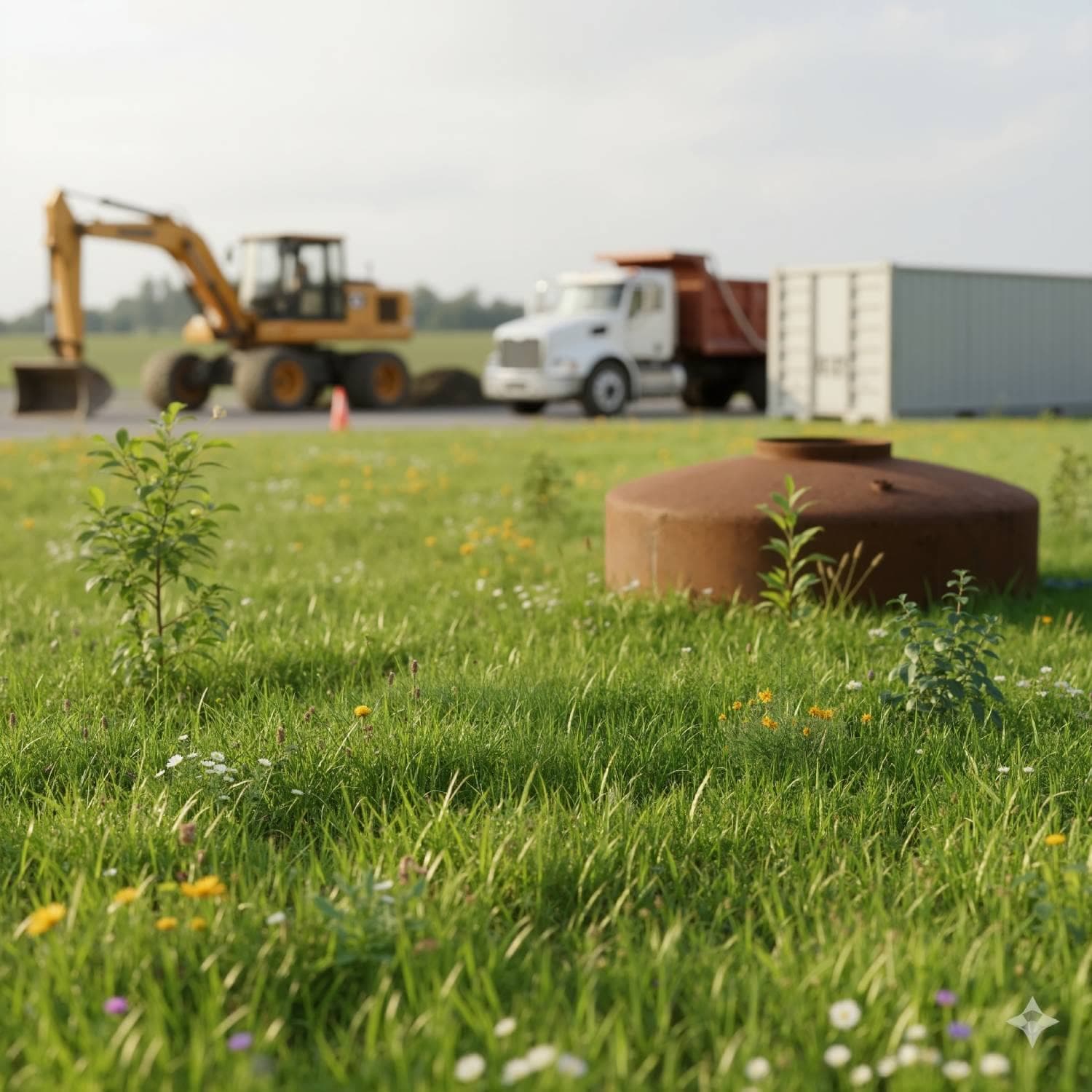
- A risky past use on the land: gas station, garage, workshop, storage of petroleum products or chemicals, scrapyard.
- A heating oil tank, in place or removed, especially if it was buried.
- Fill of unknown origin. Many lots were levelled with materials nobody kept track of.
- A risky neighbour, especially upstream: contamination moves with groundwater.
- A listing in a public registry, for the land or a neighbouring lot. See our article on contaminated sites nearby.
- Visible signs: stained soil, hydrocarbon odour, bare patches where nothing grows, pipes coming out of the ground.
- A request from your lender, or a Phase 1 that recommends checking.
On the other hand, for wooded land that has never been occupied, far from any commercial activity, an environmental soil test is rarely needed. A check of the site's history is enough to confirm it, with no drilling.
Why you don't start with drilling
Because a borehole only tells you about the spot where it is drilled. Three random boreholes on half a hectare can all miss an old garage pit. And the laboratory only finds what it is asked to look for: analyzing for hydrocarbons says nothing about metals or solvents.
That is the role of the Phase 1: reconstructing the site's history to know where to drill and what to analyze. The Quebec Environment Ministry's site characterization guide (in French) describes it as the step that sets the sampling strategy. Since June 1, 2024, field work must follow the current version of that guide.
If a recent Phase 1 already exists, the seller's for example, it can be used as a starting point. And if the source is obvious and localized, such as a tank that has just been removed, a targeted characterization may be enough.
How the test works
- The sampling plan. Based on the areas of concern, we set the number of boreholes, their location, their depth and the contaminants to analyze.
- Locating underground utilities before any drilling: gas, electricity, water, sewer.
- The boreholes. A drill rig or excavator collects soil samples at different depths. Each sample is described, then kept cold. If groundwater may be affected, monitoring wells are installed to sample it.
- The analysis, in an accredited laboratory. The contaminants depend on the history: petroleum hydrocarbons for a heating oil tank or a garage, metals for fill, volatile organic compounds for some workshops.
- The report. It compares each result with the applicable limit values, maps the exceedances and recommends next steps.
The work is done all year round, including in winter. Our Phase 2 environmental site characterization page describes our method in detail.
Reading the results
Measured concentrations are compared with the limit values in the Land Protection and Rehabilitation Regulation. These limits depend on the use allowed by zoning: Schedule I applies in particular to residential land, and the less stringent Schedule II to industrial, commercial or institutional land, with exceptions. The report must therefore consider what you want to do with the land, not just what it is today.
All results are below the limits. You buy knowing where you stand, and you keep a report that documents the condition of the land on the purchase date. It will be useful the day you sell or refinance.
Some results exceed the limits. The report shows where and, if the characterization is far enough along, over what area. You can then:
- negotiate the price based on an estimate of the work;
- ask the seller to decontaminate before the sale, with a report proving it;
- withdraw your offer, if it was conditional.
Either way, you decide with numbers rather than with a hunch. The steps of a remediation are explained in our guide to soil decontamination.
Good to know: when a characterization study is carried out under the Environment Quality Act or sent to the Minister, and it shows an exceedance, section 31.58 requires a contamination notice to be registered in the land register. It is worth discussing with the seller before the work.
What to include in the offer to purchase
The land is not yours yet. To drill on it, you need the owner's written permission. Four points deserve to be settled in the offer, with your broker or notary:
- the condition: the purchase is conditional on an environmental assessment satisfactory to you;
- access: the seller allows the visit, boreholes and sampling;
- timing: long enough for a Phase 1, then a Phase 2 if one is recommended;
- documents: the seller provides any environmental reports they have.
Also ask your lender what it requires before ordering anything: see what your lender requires on the environmental side.
What drives price and timing
No two sites cost the same to characterize. The price depends mainly on:
- the number of boreholes and their depth;
- whether wells are needed for groundwater;
- the number of samples analyzed and the contaminants looked for;
- access: open land, paved yard, inside a building;
- the turnaround requested for laboratory results.
That is why a serious quote is based on the site's history. If you have a Phase 1, attach it to your request: the price will be more accurate.
Not sure you need one?
Go step by step, from the least to the most expensive.
- A look at public registries. Prephase produces a $45 preliminary report in minutes that lists contaminated sites, flood zones and other known constraints within 300 m of the address. It is for information only, has no legal value and does not replace a Phase 1; its cost is credited if you then order a Phase 1 from Emphase.
- A Phase 1, if the preliminary report, the history or your lender justify it.
- A soil test (Phase 2), only if the Phase 1 recommends it.
Got a lot in mind and a deadline? Request a free quote or call us at (514) 688-9747 in Montreal or (418) 520-9747 in Quebec City. We travel everywhere in Quebec.